

Guides
Ethiopian coffee: from the land where it all began
No country is as closely tied to coffee as Ethiopia. Arabica has always grown wild in its highland forests, coffee is still shared there in a ceremony of its own – and some of the most aromatic coffees in the world come from here.
The home of arabica
The coffee plant Coffea arabica originates in south-western Ethiopia. In the country’s mountain forests it still grows wild in the shade of tall trees. Nowhere else is arabica’s genetic diversity as great: thousands of local varieties, often simply called “heirloom”, grow side by side.
A well-known legend tells of the goatherd Kaldi, whose goats became lively after eating red berries. Nobody knows whether it happened – it is a legend, not history. What is certain is that coffee travelled from Ethiopia to Yemen, into the Arab world and from there to Europe.
How Ethiopian coffee is grown
Most Ethiopian coffee comes from smallholders. Many families farm only a small plot, often alongside other crops. Roughly four systems are distinguished:
- Forest coffee: wild plants in natural forest, simply harvested.
- Semi-forest coffee: in the forest, but thinned and tended.
- Garden coffee: a few shrubs around the house among other crops – the most common form.
- Plantation coffee: larger, purpose-planted areas; a small share in Ethiopia.
Growing areas are often high, frequently between about 1,500 and over 2,000 metres. The cooler temperatures let the cherries ripen slowly – an important basis for the range of flavours.
Typical flavour
Ethiopian coffees are known for their range of aromas. Often described are floral notes such as jasmine, fruity notes of berries or citrus, and a lively, clean acidity. But region, processing and roast make a big difference.
Well-known coffee regions in the country include Sidamo, Yirgacheffe, Guji, Harrar, Limu and Jimma. In the trade these names stand for a style, but they don’t tell you everything about a particular lot.
Roasting decides how much of this reaches the cup. A light roast highlights acidity and florals; a medium roast rounds the coffee out with more sweetness and body. Ethera Single Origin Ethiopia, from the Ethiopian highlands, is a medium roast – balanced enough for espresso, clear enough for filter.
Washed or natural: processing
After harvest, the bean has to be separated from the fruit of the coffee cherry. Two methods are common in Ethiopia:
| Washed | Natural | |
|---|---|---|
| Process | fruit is removed, beans ferment, are washed and then dried | whole cherries dry in the sun, then the husk is removed |
| Taste | clean, floral, bright acidity | fruitier, sweeter, more body |
| Water use | high | low |
The Ethiopian coffee ceremony
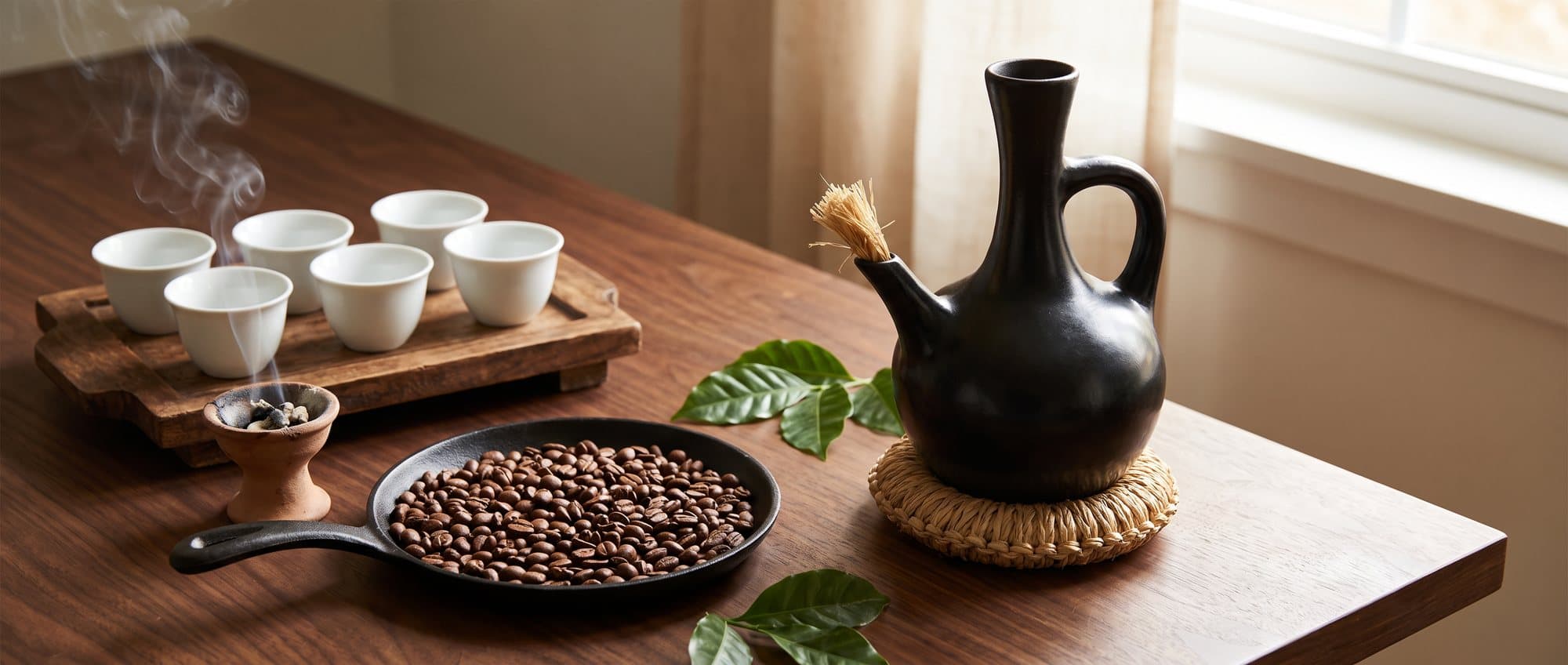
In Ethiopia coffee is called “buna”, and it is rarely drunk in passing. In the traditional ceremony the host roasts green beans in a flat pan over charcoal, lets the guests smell the aroma, pounds the beans in a mortar and boils the coffee in a “jebena”, a round-bellied clay pot with a long neck.
It is served in small handleless cups, often with sugar, sometimes with salt or butter, with incense and snacks such as roasted grain or popcorn. Traditionally there are three rounds: “abol”, “tona” and “baraka” – each a little milder than the last. The ceremony can take an hour or more, and above all it is time spent together.
Frequently asked questions
Why is Ethiopia considered the birthplace of coffee?
Because Coffea arabica comes from the mountain forests of south-western Ethiopia, where it still grows wild with greater genetic diversity than anywhere else.
What does Ethiopian coffee taste like?
Often floral and fruity with lively acidity. As a medium roast it is rounder, sweeter and more balanced.
Is Ethiopian coffee always arabica?
Practically yes – Ethiopia grows almost exclusively arabica.
What is the difference between washed and natural?
Washed coffees have the fruit removed before drying and taste cleaner; naturals dry inside the whole cherry and taste fruitier.
Is Ethiopian coffee good for espresso?
Yes, especially as a medium roast. Very light Ethiopian roasts can taste very acidic as espresso.
More guides
Arabica vs robusta: the two coffee species compared
Plant, altitude, caffeine, taste: what sets arabica apart from robusta – with a comparison table.
Buying coffee beans: a practical guide
Freshness, origin, roast and bag size: six criteria for buying coffee – and how ordering Ethera works.

How to make filter coffee
30 g per 500 ml, 94 °C, 3–4 minutes: the base recipe for pour over and machine, the right grind and the most common mistakes.